Place a bathroom runner along the main walking path, in front of a long vanity, or between the sink and shower, while keeping wet areas safe.
In American homes, bathroom layouts range from compact guest baths to large primary suites with double sinks, walk-in showers, and separate tubs. A runner rug can add warmth to cold tile, soften the look of a long floor, and make daily routines more comfortable. The best location depends on your bathroom’s shape, the spots where you stand most, and how much water reaches the floor.
Start by looking at the route you take when you enter the room, brush your teeth, get dressed, or step out of the shower. Place the runner where it serves one of these routines without blocking doors, covering floor drains, or creating a tripping hazard. A rug that looks good but stays wet or slides underfoot is not a good fit for the space.
A runner is a long, narrow rug that works well in a stretched-out area. In a bathroom, it can sit along a vanity, follow an open walkway, or connect separate fixtures visually. It does not need to cover the whole floor. A well-sized runner leaves enough visible flooring around its edges and stays clear of areas where water tends to collect.
Source: df0e4g4866x0s.cloudfront.net
1. Place the Runner Along the Main Bathroom Walkway
The main walking path is often the most practical place for a bathroom runner. This location works especially well in long bathrooms where the entrance, vanity, shower, and tub sit along a shared route. The runner gives the floor a clear visual line and creates a softer surface underfoot.
Stand at the bathroom entrance and look toward the fixtures you use most. If the room has a clear path from the door to the sink or shower, place the runner along that route. Keep it centered in the open floor area when possible, but adjust its position if one side has more traffic or a door needs extra clearance.
A runner should support movement, not interfere with it. Leave enough exposed floor near the door so the rug does not catch beneath the door as it opens. Check that the edges lie flat and that no corner folds upward when someone walks across it.
Source: casolia.com
Best for long bathrooms
A runner can visually connect the entrance, vanity, and bathing area when the floor plan creates one long walking route.
Best for shared bathrooms
A long rug can serve several household members as they move between the sink, shower, and storage areas.
Avoid crowded walkways
Do not force a wide runner into a narrow path where its edges touch cabinets, walls, or door frames.
How to Position a Runner in a Narrow Bathroom
In a narrow bathroom, place the runner lengthwise rather than across the room. Align it with the longest open section of floor and keep a visible strip of flooring on each side when space allows. This arrangement makes the layout feel orderly and helps prevent the rug from crowding the fixtures.
If the room is too narrow for a standard runner, choose a slimmer design or use a small bath mat at the main standing point instead. A rug should never be wedged tightly between the vanity and the opposite wall. That setup can make cleaning harder and may cause the edges to curl.
Measure the clear width
Measure the space between the vanity, wall, or other fixed fixtures to find a runner that fits without touching both sides.
Keep the path open
Make sure the rug does not interfere with a person passing through the room or opening a cabinet.
2. Put the Runner in Front of a Long Vanity
The area in front of a vanity is one of the best places for a bathroom runner because people often stand there several times a day. Brushing teeth, washing your face, shaving, and applying makeup can all involve standing in one spot. A soft runner can make that routine more comfortable while giving the vanity wall a finished look.
Position the rug parallel to the vanity cabinets. Aim to cover the main standing area without pushing the rug beneath the cabinet toe kick or extending it so far that it blocks the walking path. The runner should sit on the open floor in front of the sink, where feet naturally land.
The right placement depends on the vanity’s width and the amount of open floor in front of it. A long runner may work well with a wide single vanity or a double-sink cabinet. For a small vanity, a short bath mat can be more practical because it covers the main standing area without adding extra fabric.
Source: images.restoredstyle.com
For a single vanity
Use a short runner or rectangular bath mat that covers the area where you stand at the sink.
For a double vanity
Choose a runner long enough to serve the shared standing area while leaving safe clearance near the room entrance.
For a floating vanity
Keep the rug aligned with the usable floor space below the cabinet, and avoid pushing it against any low-hanging drawers or fixtures.
Should the Runner Match the Vanity Width?
A runner does not have to match the exact width of a vanity. It should look proportionate to the cabinet and fit the open floor. A rug that is slightly shorter than a wide vanity can create a balanced appearance, while a very short rug beneath a long double sink may look disconnected.
Use the cabinet edges as a visual guide, then check the actual walking space. The rug’s job is to support your routine first. A symmetrical arrangement is helpful, but safe access to drawers, cabinet doors, and the bathroom entrance matters more.
Follow the vanity line
Align the long edges of the runner with the cabinet front for a clean, coordinated look.
Check cabinet clearance
Open drawers and cabinet doors fully to make sure they do not catch the rug.
3. Place a Runner Near the Shower or Bathtub With Care
A runner can sit near a shower or bathtub when the floor layout gives it enough room to stay flat and dry between uses. The key is to place it where people step or walk after bathing without creating a slippery surface or trapping moisture beneath the rug. A long rug is not automatically the best choice for a wet area.
For a walk-in shower, a washable runner may work outside the shower entrance if water does not regularly spread across the floor. For a bathtub, position the rug beside the tub where you naturally step out. Keep it far enough from the tub edge to avoid bunching, and make sure it does not cover a drain or obstruct access to the shower.
If water frequently splashes beyond the bathing area, use a bath mat designed for that purpose or choose a rug that can be removed and dried easily. Some decorative runners have thick pile or backing that holds moisture. Such designs may be better suited to a dry vanity area than to a spot that gets wet every day.
Source: inspiration.nourison.com
Near a walk-in shower
Place the runner outside the shower entrance only when the surrounding floor stays dry enough for the rug and its backing.
Beside a bathtub
Keep the rug next to the usual exit point, with enough clearance to step out safely.
In a wet bathroom
Choose a washable, quick-drying option and lift it often so the floor underneath can dry.
Runner Rug or Bath Mat Outside the Shower?
A bath mat is usually more practical when you need a compact surface to absorb water as you step out of a shower. A runner is more useful when the bathroom has a longer open area or when you want to cover the route between several fixtures. Either option must suit the moisture level and floor surface.
You can also use both if the room is large enough. Place a dedicated bath mat at the shower exit and a separate runner along the vanity or walkway. Leave a clear gap between them so the edges do not overlap or create a raised ridge that catches bare feet.
Choose a bath mat for direct splashes
A compact mat is often easier to wash and dry when it absorbs water after each shower.
Choose a runner for a longer dry area
A runner works best when it covers an extended standing or walking zone that does not stay wet.
4. Use a Runner in a Large Bathroom to Connect Separate Areas
A large bathroom often has enough floor space for a runner to connect separate fixtures without crowding the room. If the vanity, tub, and shower sit apart from one another, a runner can create a visual link between these areas. It can also soften a large stretch of tile that otherwise feels bare.
Start with the largest open section of floor rather than trying to cover every fixture. A runner can follow the route between the entrance and vanity or sit in front of a long bank of cabinets. If the bathtub occupies a separate corner, a smaller bath mat beside it may be more useful than extending one long rug across the entire room.
In a spacious primary bathroom, a single runner often looks calmer than several small rugs scattered across the floor. However, separate mats may be more useful when people use different areas at the same time. Choose the arrangement that fits the actual walking routes rather than forcing the room into a symmetrical design.
Source: storables.com
Connect the vanity and entrance
Use the runner to guide the eye along the main open floor area without blocking the doorway.
Define a dressing area
Place a runner near a dry dressing space if you have room to stand, change clothes, or access storage.
Keep separate wet zones clear
Use individual mats near the tub or shower if one continuous rug would pass through areas that get soaked.
Should You Put a Runner Between the Tub and Vanity?
A runner can work between the tub and vanity when the space forms a natural walking route and the rug does not crowd either fixture. This placement can tie two parts of a large bathroom together. It is less suitable when the gap is narrow or when water from the tub regularly reaches the floor.
Measure the open strip between the fixtures and check how doors, drawers, and cabinet fronts move. If the runner fits without touching the tub or vanity, test its position before settling on it. If the rug makes the passage feel tight, move it in front of the vanity or choose a narrower option.
Check the walking route
Make sure the rug follows the path people actually use rather than sitting in a low-traffic area.
Avoid fixture contact
Leave enough room around the rug so it does not bunch against the tub or vanity.
5. Choose the Right Runner Placement for a Small Bathroom
In a small bathroom, a runner should cover one useful area rather than fill most of the floor. A long, narrow rug may suit a galley-style layout, but a short mat is often better in a compact bathroom with a toilet, vanity, and tub close together. The goal is to keep the floor easy to walk across and clean.
Place the rug in front of the fixture you use most often. For many people, that is the sink. If the shower exit is the main wet spot, a small bath mat may be more useful there. Avoid placing a long rug in the middle of a room if it leaves little space to stand beside the sink or open the door.
Light colors and simple patterns can help a small bathroom feel open, but the rug does not need to be pale. A darker or patterned runner can add contrast when the walls and fixtures are light. Choose the color based on the rest of the room, then make sure the material and backing suit the floor.
Source: i.pinimg.com
Use one main rug
A single well-placed rug can look less cluttered than several small mats in a tight space.
Protect the doorway
Keep the rug outside the door swing and check that the door clears its full thickness.
Keep cleaning simple
Choose a size that you can lift, wash, and dry without moving several fixtures or accessories.
Can a Runner Make a Small Bathroom Look Bigger?
A runner can make a narrow bathroom look more organized by drawing the eye along its length. This effect is strongest when the rug follows the room’s main axis and does not break the floor into several small sections. A rug that is too wide can have the opposite effect by making the floor appear crowded.
Leave some visible flooring around the runner. The open border gives the rug space and makes the layout feel less packed. If the bathroom is extremely small, a compact rectangular mat may provide the same comfort with less visual weight.
Follow the room’s shape
Use a long, narrow rug in a stretched-out room and a compact mat in a square or very tight layout.
Leave visible floor
Do not try to cover every exposed tile just because the room has limited space.
6. Measure the Bathroom Before Choosing a Runner
The best runner size depends on the usable floor area, not simply the room’s total dimensions. Measure the open space where you plan to place the rug, then account for door swings, cabinet fronts, toilet access, and nearby fixtures. A rug that fits on paper may still feel too large when people move through the room.
Measure both the length and width of the available area. If the runner will sit in front of a vanity, measure the clear floor from the cabinet front to the opposite obstruction. For a walkway, measure the usable width and leave enough exposed floor at the sides to avoid a cramped fit.
There is no single runner size that suits every bathroom. Common retail sizes vary, and a product’s actual dimensions should guide your decision. Compare the measurements with the floor plan before buying, and use painter’s tape to mark the proposed rug outline if you are unsure how much space it will occupy.
Source: i.pinimg.com
Measure the length
Mark the beginning and end of the useful area, leaving clearance near doors and fixtures.
Measure the width
Check the distance between fixed obstacles and avoid choosing a rug that fills the entire gap.
Test the outline
Use removable tape to visualize the rug’s footprint before you order or move furniture.
Example of Runner Sizing
Suppose the open floor in front of a vanity measures 60 inches wide and 30 inches deep. A hypothetical 48-inch-long by 20-inch-wide runner would leave 12 inches of total width and 10 inches of total depth beyond the rug’s footprint. If centered, that creates 6 inches of clearance at each end of the width and 5 inches at each side of the depth.
This calculation only describes the available space. It does not establish that the rug is safe or comfortable in every layout. You still need to check the door, cabinet movement, walking clearance, and whether the rug can stay flat on the floor.
Compare the actual dimensions
Use the product’s listed length and width rather than relying on labels such as small, medium, or runner.
Adjust for obstructions
Reduce the planned footprint if the outline touches a toilet, door, cabinet, or other fixed feature.
7. Match the Runner Material to Its Location
The best material depends on how much moisture the rug will face and how often you can wash it. A runner near a dry vanity has different needs from one beside a shower. Before choosing a material, consider absorbency, drying time, texture, backing, and the care instructions on the label.
Cotton rugs are often easy to wash and can absorb water, although drying time depends on thickness, construction, room airflow, and humidity. Microfiber options may feel soft and can dry relatively quickly in suitable conditions, but performance varies by product. Chenille has a textured pile that feels plush, yet a thick design may retain moisture if it does not dry well.
Flat-woven rugs can be easier to lift and may dry faster than some thick designs, but they are not automatically safe for wet floors. The backing and floor contact matter just as much as the top fabric. A decorative runner should not be treated as a substitute for a purpose-made bath mat when substantial water reaches the floor.
Source: i.pinimg.com
For a dry vanity area
Consider a comfortable cotton, microfiber, or flat-woven rug that suits your washing routine and floor surface.
For a damp shower exit
Choose a washable design that absorbs the amount of water it is likely to encounter and can dry fully between uses.
For a humid bathroom
Favor a rug that is easy to lift and dry, and avoid leaving a damp rug on the floor for long periods.
Why the Backing Matters
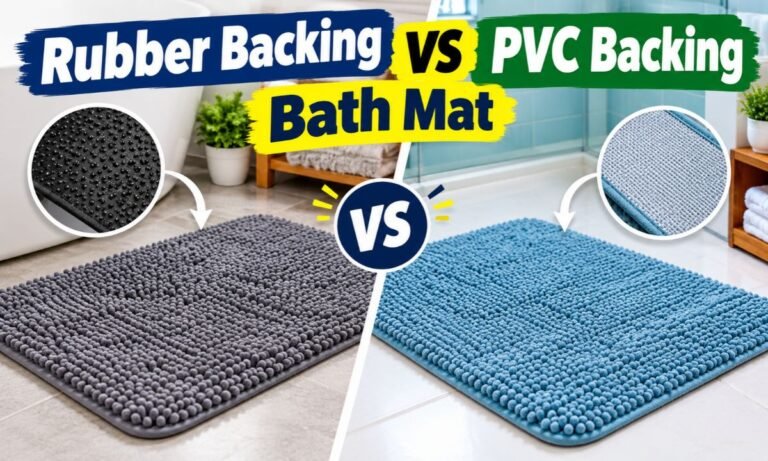
A runner’s backing affects how it behaves on tile, vinyl, stone, or another smooth bathroom floor. A rug can move when someone steps on its edge, especially if the floor is wet. Use a compatible non-slip backing or a rug pad designed for both the rug and the flooring material.
Follow the rug and flooring manufacturers’ care instructions. Some backing materials can react poorly to certain finishes or cleaning products. Check the rug after washing, since backing can wear, crack, or lose its grip over time.
Check floor compatibility
Confirm that the backing or pad is suitable for your specific floor finish.
Inspect for movement
If the rug slides, curls, or bunches, stop using it in that position until you can correct the problem.
8. Avoid Common Bathroom Runner Placement Mistakes
A good placement should make the bathroom easier to use, not harder to clean or move through. Many problems happen when people choose a rug for its color or length without checking how it interacts with doors, wet floors, and daily traffic. A few simple checks can prevent these issues.
Never assume that a heavy rug cannot slide. Water, soap residue, worn backing, and a smooth floor can affect grip. Test the rug on a dry floor, then check its position during normal use. If it moves or bunches, remove it from the walking path until you have a suitable fix.
Moisture also matters after the bathroom routine ends. A rug that stays damp against the floor can create an unpleasant smell and may contribute to surface damage, depending on the floor material and how long moisture remains trapped. Lift the rug, dry the floor, and follow the cleaning instructions rather than leaving the same damp spot covered day after day.
Source: i.pinimg.com
Blocking the door
Keep the rug outside the full door swing and check clearance with the bathroom door both open and closed.
Covering a drain
Keep the runner away from floor drains so water can flow freely and the drain remains accessible.
Placing it too close to the toilet
Leave enough space to clean around the toilet and avoid trapping moisture or dirt near the base.
Using a slippery rug
Choose a suitable non-slip solution and remove any rug that shifts underfoot.
Ignoring dampness
Lift the rug regularly, dry the floor, and wash the rug as directed.
How to Tell Whether Your Runner Is in the Wrong Spot
Your runner may need to move if you repeatedly step around it, catch a toe on an edge, struggle to open a door, or find water trapped underneath. These signs show that the rug is not serving its intended purpose. A visually attractive arrangement is not worth keeping if it makes normal movement awkward.
Try shifting the runner a few inches, turning it to follow the main walking route, or replacing it with a smaller mat. If the floor remains wet beneath the rug, change the material or move the rug to a drier area. If the rug continues to slide, do not rely on repeated repositioning alone.
Look for curled edges
Replace or correct a rug that will not lie flat, especially in a narrow walking path.
Check beneath the rug
Lift it and inspect for dampness, residue, discoloration, or signs of floor damage.
Review daily use
Move the rug if it blocks a routine or sits in a place where nobody naturally stands or walks.
9. Style the Runner to Fit the Bathroom
Once the runner is in a useful position, coordinate it with the bathroom’s colors, textures, and fixtures. The rug can echo the vanity finish, shower curtain, towels, or wall color without matching every item. A simple design often works well when the room already has strong tile patterns or bold fixtures.
In a neutral bathroom, a patterned runner can add interest to a plain floor. In a room with colorful tile, a solid or low-contrast rug may keep the space from feeling busy. Stripes can emphasize a long layout, while small repeating patterns can help soften the look of a large floor.
Think about the rug’s texture as well as its color. A thick, plush runner may look cozy beside a dry vanity, while a lower-profile design may be easier to clean and less likely to interfere with a door. The best choice balances appearance with how the bathroom works each day.
Source: casolia.com
For a modern bathroom
Try a simple geometric pattern or a solid rug that complements the cabinet finish and hardware.
For a coastal bathroom
Consider soft blues, sandy neutrals, or subtle stripes that work with the room’s existing palette.
For a traditional bathroom
A restrained floral or classic repeating pattern can complement detailed cabinetry and traditional fixtures.
For a small bathroom
Keep the pattern and rug size proportionate to the floor so the space does not feel crowded.
Should the Runner Match Your Bath Towels?
Your runner does not need to match your towels exactly. Coordinating colors usually looks more natural than using the same pattern and shade everywhere. For example, a gray runner can work with white towels and warm wood cabinets, while a blue runner can complement neutral towels without repeating their exact color.
Choose one or two colors already present in the bathroom and use them as a guide. If the rug has a bold pattern, keep nearby textiles simpler. If the room is mostly plain, the runner can become the main decorative accent.
Repeat a color
Use a shade from the towels, shower curtain, tile, or wall art to tie the runner into the room.
Balance patterns
Pair a patterned rug with simpler towels or use a plain rug in a bathroom with patterned tile.
10. Compare the Best Runner Locations at a Glance
The best location depends on your bathroom layout, the amount of water on the floor, and the reason you want a rug. Use the table below to compare common placements before deciding where your runner should go. Treat these as practical starting points, not fixed rules for every home.
Source: i.pinimg.com
Main walkway
Best for long bathrooms with a clear path between the entrance and the main fixtures. Check that the rug leaves enough room to walk safely.
In front of a vanity
Best for daily grooming and shared sink areas. Match the rug’s length to the useful standing space.
Outside the shower
Best only when the runner can handle the moisture and dry between uses. A dedicated bath mat may be more practical.
Between the tub and vanity
Best for larger bathrooms with a wide, dry passage. Avoid this position if it makes the space feel tight.
Along a dressing area
Best for a dry section of a spacious bathroom where people stand or change clothes.
A Simple Placement Decision
If your bathroom is long and narrow, begin with the main walkway. If you have a wide vanity, test a runner parallel to the cabinets. If your main concern is water after a shower, start with a bath mat at the exit rather than placing a decorative runner in a wet zone.
If none of these positions leaves a clear, safe path, skip the runner. A smaller mat or no rug at all may be the better choice for a compact bathroom with limited floor space.
Start with function
Identify the place where a rug would make standing or walking more comfortable.
Check the floor
Confirm that the rug can stay in place and that moisture will not remain trapped underneath.
Test before committing
Mark the rug’s size with removable tape and walk through your usual routine to check clearance.
Frequently Asked Questions
Q
Where should a runner rug go in a long bathroom?
Place the runner along the main walking path or parallel to a long vanity. Keep it aligned with the room’s shape and leave enough exposed floor around the edges. Check that it does not block the door, cover a drain, or extend into a wet area where it cannot dry.
Q
Can I put a runner rug in front of the bathroom sink?
Yes. In front of the sink is one of the most useful places for a runner because you stand there for daily grooming. Align it with the vanity and make sure drawers and cabinet doors can open freely. Choose a washable rug with suitable backing for your floor.
Q
Should a bathroom runner go in front of the shower or the bathtub?
A runner can sit outside a shower or beside a bathtub if the area has enough space and the rug can handle the moisture. For a spot that gets wet after every shower, a dedicated bath mat is often easier to manage. Keep the rug flat and away from drains.
Q
How long should a bathroom runner be?
Choose a length that covers the useful standing or walking area without blocking a doorway or touching nearby fixtures. Measure the open floor first, then compare it with the runner’s actual dimensions. A runner does not need to span the full bathroom to look balanced.
Q
Can I use two rugs in one bathroom?
Yes, if the room has enough floor space for both rugs to sit flat without overlapping. A bath mat can serve the shower exit while a separate runner covers the vanity or walkway. Leave clear gaps between them and make sure neither rug creates a raised edge in the walking path.
Q
How do I stop a bathroom runner from sliding?
Use a non-slip backing or a rug pad that is compatible with both the rug and your flooring. Keep the floor clean and dry beneath the rug, and check for worn backing or curled edges. If the rug continues to move, remove it from the walking path until you can make it stable.
Q
Is a runner rug a good idea for a small bathroom?
It can work in a narrow bathroom with a clear lengthwise walkway, but it may crowd a very small room. Measure the open floor and test the proposed size before buying. If the rug blocks movement or makes cleaning harder, a compact bath mat or no rug may be a better option.
Q
How often should I dry or wash a bathroom runner?
Lift the runner regularly to let the floor underneath dry, especially after a shower or when the room is humid. Wash the rug according to its care label and whenever it becomes dirty or develops an odor. Dry both the rug and the floor fully before putting it back in place.
✦ Wrapping Up
Conclusion
The best place for a bathroom runner is where it supports your daily routine without making the floor harder to use. For most layouts, that means along the main walkway or in front of a long vanity. In a larger bathroom, a runner may also connect separate areas, while a small bathroom may need only a compact mat beside the sink or shower.
Measure the open floor, check door and cabinet clearance, and choose a material that suits the amount of moisture in the area. A rug should lie flat, stay in place, and be easy to lift for cleaning. If it slides, stays wet, or blocks movement, change its position or choose a different size.
💡 Key Takeaway
Measure the open floor, mark the runner’s outline with removable tape, and test the placement during your normal bathroom routine before buying or installing the rug.
Learn what size bath rug fits a standard U.S. tub, how to measure your bathroom, which common sizes work best, and how to avoid door and clearance problems.









One Comment