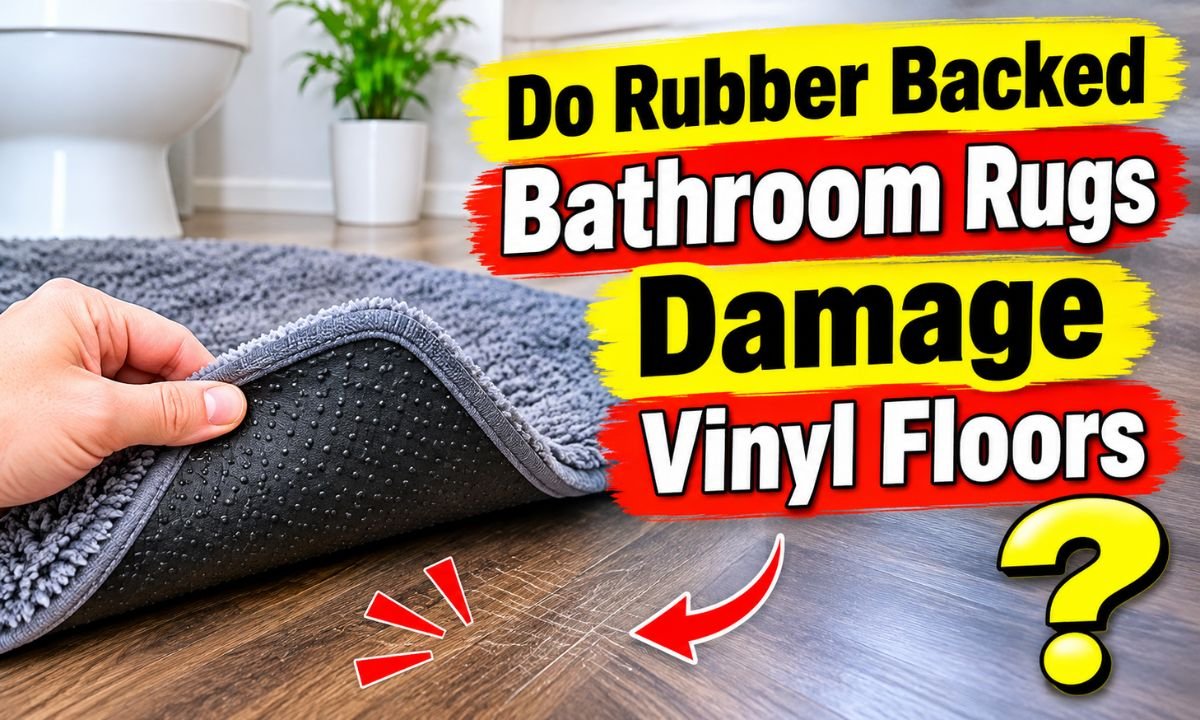
Yes. Rubber backed bathroom rugs can stain and damage vinyl floors over time. Some backings cause yellow or brown marks that may be permanent.
Vinyl flooring is common in American homes because it is easy to clean, comfortable to walk on, and works well in busy rooms. Many homeowners in the United States use it in bathrooms, kitchens, laundry rooms, and entryways. A soft bath rug near the shower or bathtub can help catch drips and make cold floors more comfortable. However, the type of backing under that rug matters more than many people realize.
Some rubber and latex backings can react with vinyl flooring. This reaction may leave yellow, brown, or dark stains beneath the rug. The risk is not limited to old floors or cheap bath mats. Flooring manufacturers, including Armstrong, warn that rubber and latex backed mats can cause lasting discoloration. The safest approach is to choose a mat that is clearly labeled as suitable for vinyl floors, keep the area dry, and lift the rug often to inspect the surface.
Source: flooringvilla.com
Why Rubber Backed Bathroom Rugs Can Damage Vinyl Floors
Rubber backed bathroom rugs can damage vinyl floors through a chemical reaction between the backing and the floor surface. This issue is different from ordinary dirt or a spill. Some rubber materials contain oils, additives, and antioxidants that help the rubber stay flexible and resist breaking down. Over time, certain compounds can move from the rubber into the vinyl surface.
This process is often called plasticizer migration or rubber staining, depending on the materials involved. Plasticizers are compounds used in some flexible vinyl products to help them bend without becoming brittle. When incompatible materials stay in contact, chemical movement may occur and change the look or feel of the floor.
Forbo Flooring Systems explains that oils in some standard rubber products can migrate into PVC flooring and leave brown or yellow marks. Its technical bulletin warns that these stains may be impossible to remove. This is why a bath mat that looks harmless can leave a lasting mark after sitting in one place for a long time.
The risk depends on the exact rubber formula, the vinyl flooring, and the conditions in the room. Not every rubber material behaves in the same way. Still, flooring manufacturers commonly advise against ordinary rubber or latex backed mats unless the backing has been confirmed as non-staining and suitable for that floor.
Source: i.pinimg.com
Chemical interaction
Some compounds in rubber backing can move into the vinyl surface and change its color.
Long contact
A rug left in the same spot for a long time gives incompatible materials more time to interact.
Permanent marks
Some stains become part of the affected surface and cannot be removed with ordinary floor cleaners.
Different backing formulas
Natural rubber, synthetic rubber, and latex products do not all have the same chemical makeup or staining risk.
What Is Plasticizer Migration?
Plasticizer migration is the movement of certain chemical compounds from one material into another. Flexible vinyl flooring may contain plasticizers that help it remain soft and flexible. Some rubber products also contain oils and other compounds that can interact with vinyl.
When the materials touch for an extended period, the floor may develop a color change. This can appear as a yellow or brown patch that follows the shape of the rug backing. The mark may remain even after the rug is removed and the floor is cleaned.
The exact chemical reaction depends on the products involved. It is not possible to predict the risk from the word rubber alone. That is why a manufacturer-approved, non-staining backing is a better choice than relying on appearance or a short trial.
Does Bathroom Moisture Make the Problem Worse?
Moisture is another reason to avoid leaving a bathroom rug in one place all day without checking beneath it. Water from showers, baths, and wet feet can collect under a mat. This trapped moisture may slow drying and create conditions for odors, mildew, or mold on the rug and nearby materials.
Moisture is not the same as chemical rubber staining. A wet rug does not automatically cause plasticizer migration. However, a damp bathroom creates an additional maintenance problem, especially when the rug has a backing that does not allow air to move freely.
After a shower, lift the rug and check both sides. Allow the floor and the backing to dry before putting the rug back. This simple habit helps reduce moisture problems even when the mat is made from a floor-safe material.
What Types of Vinyl Flooring Are at Risk?
Several types of vinyl flooring may be affected by unsuitable rubber backed rugs. The risk is not limited to one style or installation method. Sheet vinyl, luxury vinyl plank, and luxury vinyl tile are all types of resilient flooring that need compatible rug backings.
Luxury vinyl plank, often called LVP, is designed to look like wood. Luxury vinyl tile, or LVT, often has a stone or tile appearance. Sheet vinyl comes in large rolls and has fewer seams across the room. Although these products differ in construction, they can still be affected by certain chemicals in rubber.
Floor & Decor advises against using natural rubber, synthetic rubber, or latex backed rugs on any type of vinyl flooring. Its guidance explains that these materials can react with the top layers and cause staining or discoloration. Armstrong also warns that some rubber and latex backed mats can permanently stain its vinyl products.
A rigid core or waterproof label does not mean that every surface contact is safe. Waterproof flooring refers to the flooring material’s resistance to water. It does not mean that the surface cannot react with chemicals from a rug, furniture foot, or other household item.
Source: homekitchtech.com
Sheet vinyl
This flexible flooring may develop discoloration when incompatible rubber materials remain in contact with its surface.
Luxury vinyl plank
LVP can suffer staining from unsuitable rug backings even when the planks are water-resistant or waterproof.
Luxury vinyl tile
LVT also needs compatible mats and floor protectors to avoid unwanted chemical marks.
Peel-and-stick vinyl tiles
These floors need extra care because their surface and adhesive system may have product-specific maintenance limits.
Does Waterproof Vinyl Mean Rubber Mats Are Safe?
No. Waterproof and chemical-resistant are not the same thing. A waterproof vinyl plank may resist water entering through the surface, but that does not make it immune to staining from rubber compounds.
For example, a homeowner may install waterproof LVP in a bathroom and assume any bath mat is suitable. The mat may keep water off the floor, yet its backing could still cause a chemical stain after prolonged contact.
Read the flooring warranty and care instructions before using any mat. If the manufacturer does not list a backing as compatible, ask for written confirmation rather than assuming the waterproof label covers it.
Signs That a Rubber Backed Rug Is Damaging Your Vinyl Floor
The first sign of a problem is often a color change beneath the rug. You may notice a yellow, tan, brown, or gray patch when you move the mat. The affected area may match the shape of the backing or show a pattern from its small rubber dots.
Not every mark means the floor has suffered permanent damage. Dust, soap residue, body oils, and dirt can also collect under bathroom rugs. Start by cleaning the exposed area with a method approved by the flooring manufacturer. If the mark remains after gentle cleaning, a chemical reaction may be the cause.
Pay attention to changes in the surface as well. A patch that feels sticky, unusually soft, rough, or different from the surrounding floor needs closer attention. Do not scrape or use strong chemicals to test it. Aggressive cleaning may make the problem worse.
Source: icorkfloor.com
Yellow or brown patches
These may indicate chemical staining from an incompatible rubber or latex backing.
Dark marks
Some rubber products can leave gray or dark stains, especially when their compounds transfer to the floor.
A pattern that matches the rug
Marks that follow the shape of the backing may point to prolonged contact rather than an unrelated spill.
Sticky or altered surface
An unusual surface feel may indicate residue or material damage and should be checked before further cleaning.
A mark that stays after cleaning
If a stain remains after approved gentle cleaning, it may not be ordinary dirt.
How to Tell a Rubber Stain From Ordinary Dirt
Lift the rug and inspect the floor in good light. Look at the outline of the stain and compare it with the shape of the backing. A mark that follows the backing pattern deserves attention.
Use a clean, soft microfiber cloth and a small amount of the floor cleaner approved for your vinyl product. Follow the cleaner’s directions and avoid flooding the floor. Wipe gently, then dry the area.
If the surface looks clean but the color remains, stop cleaning. A chemical stain may have affected the vinyl itself. More scrubbing is unlikely to solve the problem and could scratch or dull the protective finish.
When Should You Stop Using the Rug?
Remove the rug as soon as you notice unexplained yellowing, dark patches, sticky residue, or surface changes beneath it. Do not put it back in the same spot while you investigate the cause.
Check the label for the backing material. If it says rubber or latex and does not confirm compatibility with vinyl, replace it with a suitable alternative. If the label is unclear, contact the mat maker.
If the flooring has become soft, raised, cracked, or damaged at the seams, contact the flooring installer or manufacturer. A simple cleaning method cannot repair a damaged plank or sheet.
Which Bathroom Rug Backings Are Safer for Vinyl Floors?
The safest bathroom rug is one that has a backing specifically approved for your vinyl flooring. Look for clear wording such as suitable for vinyl floors, non-staining, or compatible with luxury vinyl. A general non-slip label is not enough because it does not confirm that the backing will avoid chemical staining.
Armstrong recommends colorfast mats with non-staining vinyl backing or woven rugs for its flooring. It also identifies polypropylene-backed mats as an option for certain vinyl products. These recommendations show why the material and the manufacturer’s approval matter more than the rug’s appearance.
A rug can be soft, absorbent, and attractive while still having an unsuitable backing. Before buying a new bath mat, check both the top fabric and the underside. If the manufacturer does not identify the backing material, ask the seller for details.
Source: plasticranger.com
Non-staining vinyl backing
This can be a suitable choice when the mat maker confirms that the backing is compatible with your exact vinyl floor.
Woven rugs
A woven rug without an incompatible rubber coating can be a practical option. Check whether it needs a separate floor-safe pad.
Polypropylene backing
Some flooring makers recommend this material, but you should still confirm compatibility with your flooring product.
Breathable backing
A backing that allows air movement can help the area dry, although breathability alone does not prove chemical compatibility.
Are Microfiber Bathroom Rugs Safe?
Microfiber describes the rug’s fabric, not its backing. A microfiber bath mat may absorb water well, but the material underneath can still cause a problem.
Some microfiber rugs have rubber or latex coatings to help them grip the floor. Others use different backing materials. Check the product details before placing one on vinyl.
If you prefer microfiber because it feels soft and dries quickly, choose a model whose backing is specifically approved for vinyl flooring. Also check its washing instructions so regular cleaning does not damage the backing.
Are Memory Foam Bath Mats Safe?
Memory foam is the soft layer inside a bath mat. It is not proof that the entire rug is safe for vinyl. Many foam bath mats have a separate backing that provides grip.
Check whether that backing contains rubber, latex, or PVC. Ask the manufacturer if it is suitable for your floor. A comfortable top layer does not cancel out the risk from an incompatible underside.
Memory foam mats may also take longer to dry than thinner woven rugs. Lift them after use and allow both sides to dry before returning them to the floor.
Is a PVC Backing Safe for Vinyl?
PVC is a type of plastic used in many household products. Some vinyl flooring makers recommend certain vinyl-backed mats, but this does not mean every PVC-backed product is automatically safe.
Different PVC products can contain different additives. Some combinations may be incompatible with particular vinyl floors. Look for a non-staining statement and confirmation from the flooring manufacturer.
Do not assume that two products are compatible just because both contain vinyl or PVC. Their exact formulas and surface treatments may differ.
How to Protect Vinyl Floors When Using Bathroom Rugs
You can use bathroom rugs without putting your vinyl floor at unnecessary risk. The key is to choose a compatible backing, prevent water from collecting underneath, and inspect the floor on a regular basis.
A bathroom rug should catch water without creating a hidden damp area. It should also stay in place when someone steps on it. A mat that slides across wet vinyl can create a fall hazard, so floor protection and slip control both matter.
Follow these steps when setting up a new bath mat. They are useful for homes with sheet vinyl, LVP, and LVT, but your flooring maker’s care guide should always take priority.
Source: thehomesihavemade.com
Step 1: Identify your flooring
Find out whether you have sheet vinyl, LVP, or LVT. Check the product name and care instructions if you have them.
Step 2: Check the rug backing
Read the label and look for a clear statement that the backing is non-staining and suitable for vinyl flooring.
Step 3: Ask when details are unclear
Contact the rug maker or flooring manufacturer before using an unverified backing.
Step 4: Start with a clean, dry floor
Remove dust, soap residue, and water before placing the new mat.
Step 5: Lift and inspect the rug
Check beneath the mat after showers and during routine bathroom cleaning.
Step 6: Dry both surfaces
Allow the rug backing and the vinyl floor to dry before putting the mat back.
How Often Should You Lift a Bathroom Rug?
Lift your bathroom rug after a shower or whenever water gets underneath it. This is especially useful in a bathroom with poor airflow or a mat that takes a long time to dry.
For a mat used every day, include an inspection during your regular bathroom cleaning routine. A weekly check is a practical starting point, but it is not a guarantee against chemical staining.
Look for moisture, dirt, color changes, and damage to the backing. Clean the rug according to its care label and allow it to dry fully before returning it to the floor.
How to Keep a Bath Mat From Sliding on Vinyl
A bath mat must stay in place to help reduce slips. However, do not solve the problem by placing an ordinary rubber rug pad beneath it. That may introduce the same chemical staining risk as a rubber-backed mat.
Choose a mat with a backing that the flooring manufacturer approves for vinyl. If you need an extra grip layer, look for a product that clearly states it is safe for your exact flooring type.
Keep the floor clean and dry. Soap residue and water can make the surface slippery. If a mat repeatedly moves, replace it with a properly sized product that has a compatible grip system.
Should You Leave a Bathroom Rug on the Floor All Day?
You do not need to remove every floor-safe bath mat after each use. However, lifting it regularly is a good habit, especially after a shower or a large splash.
A rug that remains damp can develop an unpleasant smell. The floor beneath it may also stay wet for longer than the rest of the room. Regular lifting allows you to check the surface and improve airflow.
If the mat has a rubber or latex backing that has not been approved for vinyl, removing it each night is not a reliable fix. The safer choice is to replace it with a compatible product.
How to Remove Yellow or Brown Stains From Vinyl Floors
If you find a stain beneath a rubber backed bathroom rug, remove the rug first and clean the area gently. The stain may be ordinary dirt, surface residue, or a chemical change in the vinyl. The right treatment depends on which problem you have.
Do not begin with bleach, acetone, paint thinner, abrasive powder, or a strong solvent. These products may harm the floor’s protective finish or make the discoloration worse. Use only a cleaner approved by the flooring manufacturer.
Some rubber stains are permanent. Forbo’s technical bulletin describes brown-yellow marks caused by rubber compounds migrating into PVC flooring and warns that these marks may be impossible to remove. If the color has changed within the vinyl itself, ordinary household cleaning may not restore it.
Source: icorkfloor.com
Step 1: Remove the rug
Stop further contact between the backing and the floor. Do not put the same mat back in place.
Step 2: Inspect the affected area
Check the color, surface feel, and outline of the mark. Look for signs of residue or damage.
Step 3: Use an approved cleaner
Follow your floor manufacturer’s cleaning instructions and use a soft microfiber cloth.
Step 4: Wipe and dry gently
Avoid excessive water and harsh scrubbing. Dry the area with a clean, soft cloth.
Step 5: Check the result
If the mark remains or the surface has changed, stop cleaning and ask the flooring manufacturer or installer for advice.
What If the Yellow Stain Will Not Come Off?
A stain that remains after approved cleaning may be chemical discoloration rather than dirt. This can happen when compounds from rubber backing interact with the vinyl surface.
Do not keep scrubbing in the hope that the color will disappear. Repeated friction can wear the protective layer and leave a dull or rough patch.
Contact the flooring maker or a qualified flooring professional. Share the product name, the age of the floor, the type of rug backing, and photos of the affected area. This information can help them assess whether the mark is on the surface or within the flooring material.
Can You Use Baking Soda or Vinegar?
Baking soda and vinegar are common household cleaning products, but they are not universal solutions for vinyl flooring. Baking soda can act as a mild abrasive, while vinegar is acidic.
Using either product without checking the flooring care guide may affect the surface finish. A chemical stain caused by rubber backing may also remain even after these products are used.
Use a cleaner approved for your flooring instead. If you cannot identify the floor brand, ask a flooring retailer or installer to help you find the right care instructions.
When Does Vinyl Flooring Need Repair or Replacement?
A color mark alone does not always mean the plank or sheet needs replacement. If the floor remains smooth, firm, and intact, the issue may be limited to appearance.
However, a soft spot, crack, lifted edge, bubbling, or damaged seam needs a closer inspection. These signs may point to a problem beyond simple staining.
A flooring professional can assess the affected area and explain whether a repair, plank replacement, or other work is appropriate. Do not attempt to heat, sand, or peel the floor to remove a stain.
Common Mistakes to Avoid With Bathroom Rugs on Vinyl
Many flooring problems start with a small assumption: if a rug is sold for bathrooms, it must be safe for every bathroom floor. That is not always true. A bath mat may be made for wet feet but still have a backing that is unsuitable for vinyl.
Choosing a rug by its color, thickness, or price alone can also lead to trouble. The backing material and compatibility information are more useful when protecting the floor. Read the product label before bringing a new mat home.
Source: flooringvilla.com
Assuming every non-slip mat is safe
Non-slip describes grip, not chemical compatibility. Check the backing material and its vinyl flooring approval.
Trusting the waterproof flooring label
Waterproof flooring can still be stained by certain chemicals in rug backing.
Leaving a damp rug in place
Trapped moisture can cause odors and create conditions for mildew or mold.
Using an unapproved rug pad
A separate pad can cause the same problem if its material reacts with vinyl.
Scrubbing a stain with harsh products
Strong chemicals and abrasive tools may damage the floor’s protective surface.
Ignoring the flooring warranty
Some flooring products have specific restrictions on mats, pads, and cleaning products.
Why a Cheap Rug May Cost More Later
A low-cost bath mat may seem like a simple way to protect a new vinyl floor. But if the backing causes a permanent stain, replacing the rug will not solve the problem.
The better approach is to check the backing before buying. A clear non-staining statement and confirmation from the flooring maker are more useful than a low price or a claim that the mat works on all floors.
You do not need an expensive bath mat to protect vinyl. You need one made with compatible materials and a design that can dry between uses.
What to Check Before Buying a Bathroom Rug
Before buying a new bath mat, look beyond the fabric and color. The backing should be compatible with your floor, the rug should fit the bathroom space, and the material should be easy to dry and clean.
A useful product description should identify the backing material and explain whether it is safe for vinyl. If the seller only says non-slip or waterproof, ask for more information. These terms do not confirm that the backing is non-staining.
The following comparison can help you narrow down your choices. It is a general guide, not a guarantee that every product made from a listed material will work with every vinyl floor.
Source: homekitchtech.com
Bathroom Rug Backing Comparison
Use this table to compare common backing types before buying. Always check the exact product and your flooring manufacturer’s care instructions.
Non-staining vinyl backing
Often a suitable option when the product is specifically approved for the vinyl flooring in your bathroom.
Approved polypropylene backing
Recommended for some vinyl products. Check the exact floor manufacturer’s compatibility guidance.
Woven backing
Can be a practical choice if it has no incompatible coating and does not require an unsafe rug pad.
Natural rubber backing
Generally avoid it unless the manufacturer confirms that the exact product is non-staining and suitable for vinyl.
Synthetic rubber backing
Can cause discoloration. Do not assume synthetic rubber is safer than natural rubber.
Latex backing
Many vinyl flooring makers warn against latex-backed rugs because some formulas can stain vinyl.
Unknown backing
Avoid using it until the manufacturer confirms the material and its compatibility.
Questions to Ask Before Buying
A few direct questions can help you avoid an unsuitable product. Ask the seller whether the backing contains natural rubber, synthetic rubber, latex, or PVC. Then ask whether the finished product has been confirmed as non-staining on vinyl flooring.
If you have luxury vinyl plank, give the seller the brand and product name. A general claim that a rug is safe for hard floors may not be enough. You want compatibility with your specific flooring type.
Keep the product label and care instructions after purchase. They may be useful if you need to contact the seller or flooring manufacturer later.
Research Findings and Important Evidence Limits
The guidance in this article is based on published flooring care instructions and technical information, not on a hands-on test of bathroom rugs. Several sources support the main warning about rubber and latex backed products.
Armstrong’s flooring FAQ explains that antioxidants used in some rubber and latex backings can permanently stain its luxury vinyl and sheet vinyl products. It recommends colorfast mats with non-staining vinyl or polypropylene backing and woven rugs for the relevant flooring products.
Floor & Decor gives a broad warning against natural rubber, synthetic rubber, and latex backed rugs on vinyl floors. Its guidance identifies discoloration and staining as possible outcomes of contact with the floor’s top layers.
Forbo Flooring Systems provides a more technical explanation. Its bulletin describes how oils in certain rubber products can migrate into PVC flooring and cause brown-yellow stains that may be impossible to remove.
Sherwin-Williams also advises avoiding rubber and latex backed mats because they can eventually create permanent stains. Its vinyl care guidance recommends breathable rug backing and checking the maintenance instructions for the exact flooring product.
These sources agree on the main practical point: ordinary rubber or latex backing is not a safe default for vinyl flooring. However, they do not establish that every rubber formula will stain every vinyl product or that every alternative backing is universally safe.
Source: thehomesihavemade.com
DOCUMENTED
Flooring manufacturer guidance warns about rubber and latex backed mats and the risk of lasting discoloration.
DOCUMENTED
Forbo describes rubber-related staining of PVC flooring and the movement of residual oils into the floor.
ANALYSIS
Choosing a backing approved for the exact flooring product reduces the risk of an incompatible material being left in contact with the floor.
NOT ESTABLISHED
There is no universal safe contact period that guarantees a rubber backed bath mat will not stain vinyl.
NOT ESTABLISHED
The fact that a mat uses a particular broad material category does not prove that every product made from that material is compatible.
Competitor Coverage and Useful Reader Gaps
The reviewed material includes flooring manufacturer guidance, a flooring retailer FAQ, a flooring care article, and a technical bulletin. The strongest coverage explains the staining risk and recommends non-staining alternatives. The practical gaps are mainly about everyday bathroom use.
The following gap map separates questions that were directly identified in the reviewed material from reasonable next questions based on the reader’s task. An inferred question is not a claim about search volume or verified search demand.
Can rubber backed bath mats stain LVP?
OBSERVED QUESTION. Covered by Floor & Decor and Armstrong. Reader benefit: understand that luxury vinyl is not exempt from rubber staining. Priority: high.
How can I tell if a yellow patch is permanent?
INFERRED NEXT NEED. The Forbo bulletin explains that some rubber stains are permanent, but a simple home inspection method is not fully covered. Reader benefit: avoid damaging the floor with harsh cleaning. Priority: high.
How often should I lift a bathroom rug?
INFERRED NEXT NEED. The inspected flooring sources focus more on material compatibility than daily bathroom routines. Reader benefit: reduce trapped moisture and spot early changes. Priority: medium.
Is a memory foam bath mat safe for vinyl?
INFERRED NEXT NEED. The reviewed manufacturer guidance addresses backing materials rather than memory foam as a fabric or filling. Reader benefit: learn to inspect the underside instead of relying on the top material. Priority: medium.
Can I remove a permanent rubber stain?
OBSERVED QUESTION. Forbo explains that certain rubber stains cannot be removed. Reader benefit: avoid harsh cleaning attempts and seek professional assessment. Priority: high.
Does waterproof LVP resist chemical staining?
INFERRED NEXT NEED. Armstrong explains waterproofing limits and mat compatibility in separate guidance. Reader benefit: correct the mistaken belief that waterproof means chemical-proof. Priority: high.
Frequently Asked Questions
Q
Do rubber backed bathroom rugs always damage vinyl floors?
No. Not every rubber backing will cause a stain on every vinyl floor. The result depends on the rubber formula, the flooring material, and the conditions where the products touch.
However, several flooring manufacturers warn against ordinary rubber and latex backed rugs because they can cause permanent discoloration. The safest choice is to use a mat that is specifically confirmed as non-staining and compatible with your flooring.
Q
Can I use a rubber backed bath mat on vinyl if I remove it every day?
Removing a rug regularly helps you inspect the floor and allows trapped moisture to dry. However, it does not guarantee protection from chemical staining.
If the backing is not approved for vinyl, replacing the mat is a better solution than relying on daily removal. Even regular inspections cannot establish that an incompatible backing will never stain the floor.
Q
Why does my vinyl floor turn yellow under a bathroom rug?
A yellow patch may be caused by chemical interaction between the rug backing and the vinyl flooring. Some rubber products contain oils and additives that can migrate into the floor and change its color.
Soap residue, dirt, and other materials can also cause discoloration. Clean the area gently with an approved vinyl floor cleaner. If the yellow color remains, contact the flooring manufacturer because the mark may be permanent.
Q
Are latex backed bathroom rugs safe for vinyl plank floors?
Latex backed rugs are generally not recommended for vinyl plank floors unless the exact product is confirmed as non-staining and compatible. Natural and synthetic latex or rubber materials can cause discoloration on some vinyl products.
Check the LVP manufacturer’s maintenance guide before using a latex backed mat. A non-staining vinyl-backed or approved woven rug may be a more suitable option.
Q
Are microfiber bath mats safe for vinyl floors?
They can be, but microfiber alone does not tell you whether a bath mat is safe. Microfiber describes the fabric on top, while the backing may contain rubber, latex, PVC, or another material.
Check the underside and the manufacturer’s compatibility statement. Choose a product confirmed as non-staining and suitable for your vinyl floor.
Q
Can I put a rug pad under a bathroom rug on vinyl flooring?
You can use a separate rug pad only if its material is approved for your vinyl flooring. An ordinary rubber or latex pad can create the same staining risk as a rubber backed bath mat.
Check both the rug and the pad. The combination must be compatible with the floor, and the pad should not trap excessive moisture.
Q
Can I remove permanent rubber marks from vinyl flooring?
Some rubber marks can be cleaned if they are only surface residue. However, stains caused by chemical migration may be permanent and may not respond to ordinary floor cleaners.
Start with a cleaner approved by the flooring manufacturer. Avoid bleach, strong solvents, abrasive powders, and aggressive scrubbing. If the mark remains, ask the flooring manufacturer or a qualified flooring professional to assess it.
Q
Is polypropylene backing safe for vinyl flooring?
Some flooring manufacturers recommend polypropylene-backed mats for their vinyl products. Armstrong, for example, identifies non-staining polypropylene-backed mats as an option in its care guidance.
Still, check the exact product and your flooring instructions. A general material name does not guarantee that every backing formula or finished rug will be compatible.
Q
Does a waterproof vinyl floor need a special bathroom rug?
Yes. Waterproof flooring can still be affected by unsuitable rug backing. Waterproofing helps protect the flooring material from water, but it does not prevent every chemical reaction.
Choose a bath mat with a backing approved for vinyl and lift it regularly so the floor can dry.
Q
Should I replace a bathroom rug if its rubber backing is cracking?
Yes, replacing a bath mat with a cracked or crumbling backing is a sensible step. Loose backing particles can leave residue, reduce grip, and make the mat harder to clean.
Before buying another rug, check that its backing is non-staining and approved for vinyl flooring. Also inspect the floor beneath the old mat for discoloration or residue.
✦ Wrapping Up
Conclusion
Rubber backed bathroom rugs can damage vinyl floors, mainly through discoloration and chemical staining. Some rubber and latex compounds can react with the vinyl surface and leave yellow, brown, or dark marks. In certain cases, these stains cannot be removed with normal cleaning.
The best way to protect your floor is to choose a bath mat with a backing that is specifically approved for vinyl. Non-staining vinyl-backed mats, certain polypropylene-backed products, and suitable woven rugs may be good options. Always check the flooring manufacturer’s care instructions before making a choice.
Good maintenance matters too. Lift your rug after showers, check for trapped water, clean the floor gently, and allow both surfaces to dry. If you already see a stain, remove the rug and avoid harsh cleaning products. A flooring professional can help determine whether the mark is surface residue or permanent damage.
💡 Key Takeaway
Before placing a bathroom rug on vinyl flooring, check its backing material and confirm that the exact product is labeled non-staining and suitable for vinyl. Avoid ordinary rubber and latex backed mats, inspect beneath your rug regularly, and keep the floor dry.